AI Accountant: A New Level of Accounting Quality
The whole "AI will replace accountants" debate misses the point. Good accounting runs on judgment: how to classify a transaction, where the risk is, what to tell the tax office. What drowns it is the mechanics — hundreds of bank statement lines, a stack of source documents, e-invoice (ESF) deadlines. An AI accountant takes over exactly that mechanics, and the books don't just get cheaper to keep — they get better: no missed documents, no overdue invoices, no "I'll post it at month-end."
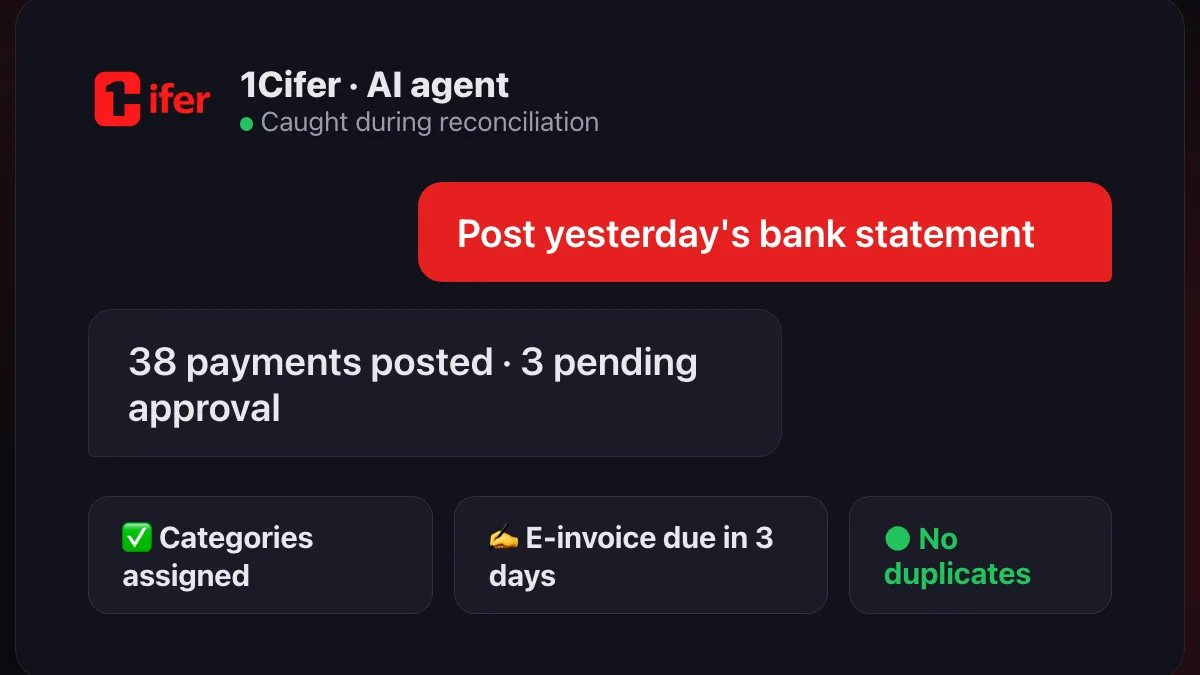
Not a replacement — a different level of quality
Look at what an accounting team's day is made of — and what in it actually requires expertise:
| Task | Before | With an AI agent |
|---|---|---|
| Post the bank statement | An hour or two of manual matching | The agent posts it; anything uncertain goes to approval |
| Enter source documents | Retype the delivery note by hand | Snap a photo — a draft entry is ready |
| E-invoice deadlines | Keep them in your head or on sticky notes | The agent reminds you ahead of time, for every sale |
| Find a duplicate or discrepancy | Surfaces at month-end close | A signal the moment it appears |
Not a single line on the right removes the accountant. Every one of them removes a reason gaps used to appear in the books.
Bank statement posting — automatic
The agent matches every payment to a counterparty and expense category — not by "magic," but from the history of your own past entries: you've always used this category for this vendor, this payment repeats every month. Confident lines get posted right away; uncertain ones go into a "pending approval" queue — the agent doesn't guess.
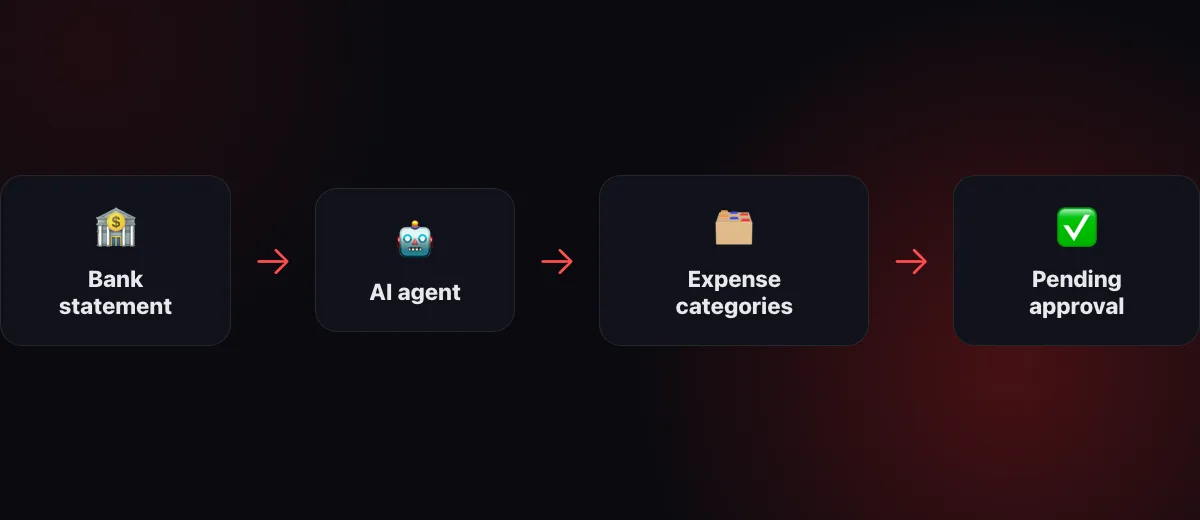
The agent remembers every correction: fix a category once, and from then on it applies it itself. Within a month or two the approval queue gets short and expense categories become consistent across the whole ledger — something you feel immediately in your management reports.
Source documents from a photo
A delivery note, an invoice, a receipt — take a photo, and the agent extracts the details, counterparty, amounts and VAT, then prepares a draft entry. It doesn't just "save the picture somewhere" — it takes the document all the way into the books: the accountant only has to glance and approve. The paperwork pile stops building up until month-end — documents land in the ledger the day they appear.
E-invoice deadlines under control
Electronic invoices come with a hard issue deadline — as a general rule, 15 calendar days from the transaction date, and missing it means fines. The agent sees the sales in your books and reminds you in advance: which shipment still has no e-invoice issued, and how many days are left. No sticky notes on the monitor — the reminder arrives on its own, to the person who issues it.
Reconciliation and early signals
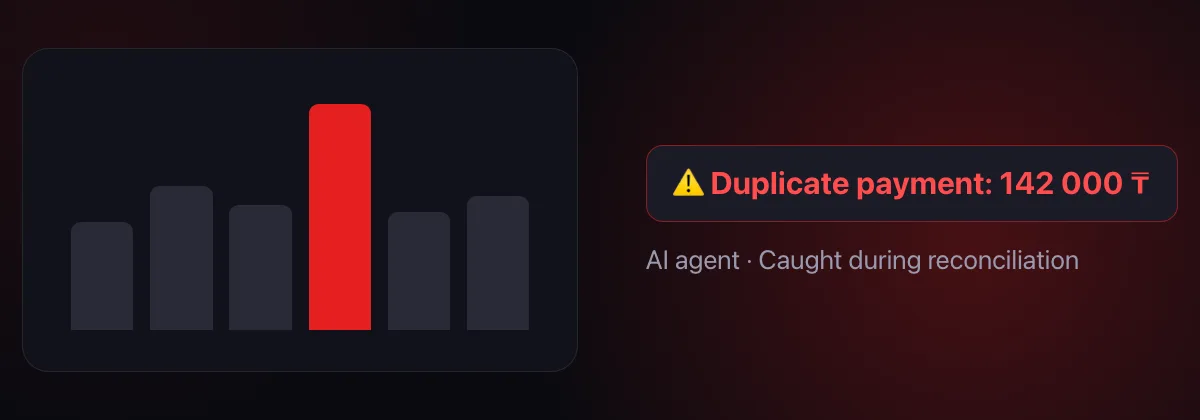
The agent watches the data continuously, so problems surface the moment they appear — not at month-end close: a duplicate payment, a statement that doesn't match the books, receivables gone stale, an invoice with no payment. It's the same early-signals principle we covered in the article on running a company — just through an accountant's lens.
What you don't hand over to an AI accountant
- Signatures and submissions. Payments, filings and e-invoices are signed and sent by a human — the agent prepares and reminds.
- Judgment on complex transactions. How to book a non-standard deal is the accountant's call; the agent supplies the facts and similar precedents.
- Accountability. It can't be delegated. That's why everything the agent does is labeled and auditable: you can see what it posted and what a human did.
This isn't a limitation of the technology — it's a deliberate design: trust in the books rests on a human having the final say. More on the control loop in our article on AI agents.
How to get started
- Connect 1C ERP and your bank. 1Cifer works on top of your existing books — no migration needed.
- Spend a week reviewing drafts. The agent posts, you approve — and you see where it's right and where it's still learning.
- Turn on trusted categories. Recurring payments and well-understood counterparties run on their own; anything uncertain still comes to you.
- Add e-invoice reminders — and one whole source of missed deadlines disappears for good.
Frequently asked questions
Will an AI agent replace the accountant?
No — and it shouldn't. The agent takes over the mechanics: posting, entering source documents, reminders, reconciliation. Judgment, accountability and the signature stay with the accountant — who simply gets time back for the work that takes real thinking.
How accurately does the agent post the statement — and what about mistakes?
Confident transactions it posts from the history of your own past entries, and anything uncertain goes into a "pending approval" queue — it doesn't guess. Every entry is labeled with who created it and can be corrected; the agent learns from corrections.
Is it safe to give the agent access to the bank and 1C?
Access is read-only by default, important operations are confirmed by a human, and every step the agent takes stays in the history. The agent never sends payments — it prepares and checks.
How is it priced?
By tokens, like any request in 1Cifer: posting one statement line or recognizing one document is a small request. See usage examples on the pricing page.
Read next: What is an AI agent — in plain words · How to run a company with AI agents · Business automation: where to start
Give your accounting a second brain
1Cifer connects to 1C ERP and your bank in minutes. Statements post themselves, source documents come in from a photo, e-invoice deadlines stay under control — and the decisions stay with your people.
Request trial access